1866
Crime and Punishment (Prestupleniye i nakazaniye)
Fyodor Dostoevsky
Russian Golden Age. Russia. written in Russian.
Dostoevsky's novel follows Rodion Raskolnikov, a destitute former student in St. Petersburg who murders an old pawnbroker to test his theory that extraordinary men may transgress moral law, and then suffers guilt, pursuit by the investigator Porfiry, and a slow turn toward redemption through Sonya Marmeladova. It joins a French-derived crime-and-ideas plot to Russian Orthodox themes of suffering and resurrection.
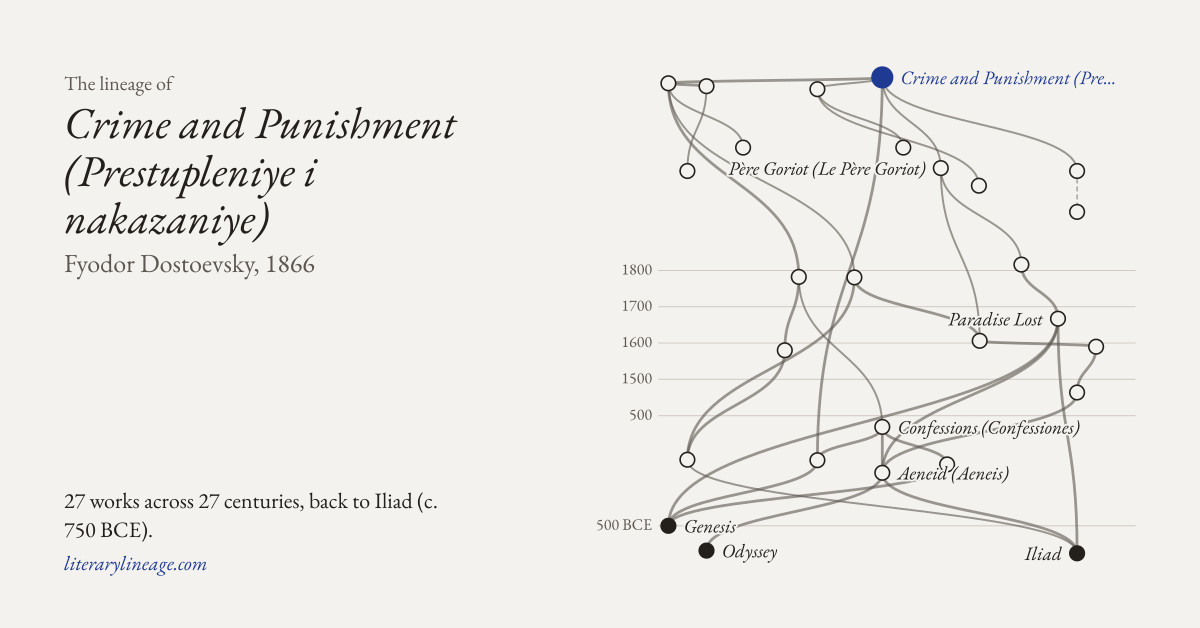
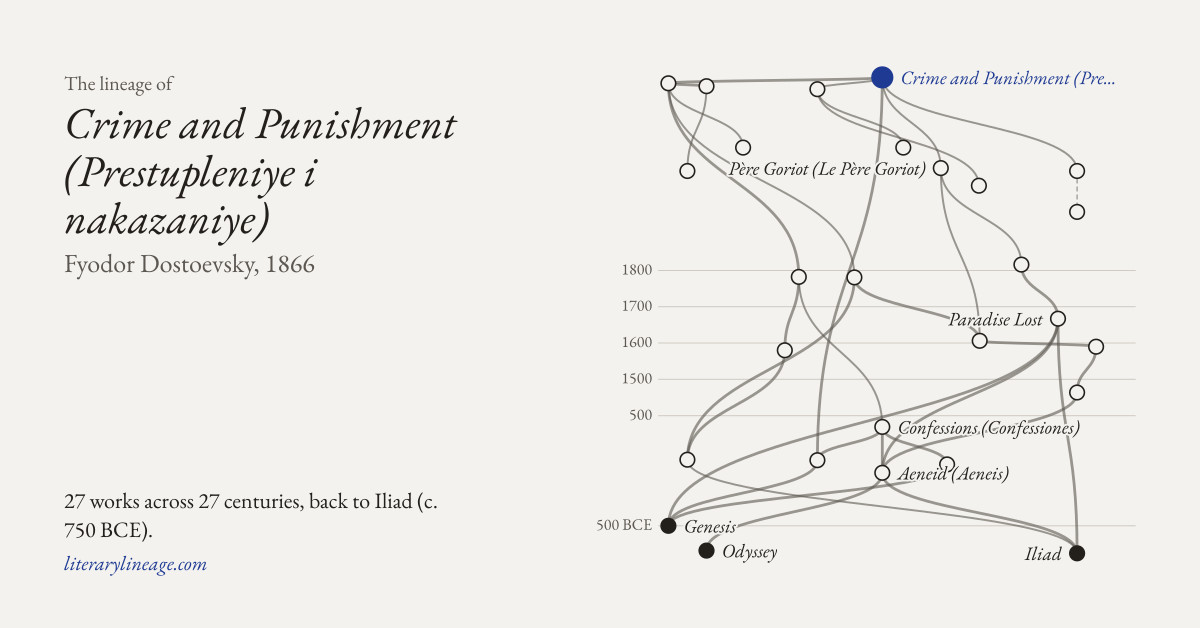
Where it came from
- Gospel of John, Anonymous c. 95 follow this thread
- Notes from Underground (Zapiski iz podpolya), Fyodor Dostoevsky 1864 follow this thread
- Père Goriot (Le Père Goriot), Honoré de Balzac 1835 follow this thread
- The Queen of Spades (Pikovaya dama), Alexander Pushkin 1834 follow this thread
- Les Misérables, Victor Hugo 1862 follow this thread
Find “Crime and Punishment (Prestupleniye i nakazaniye)” on Amazon